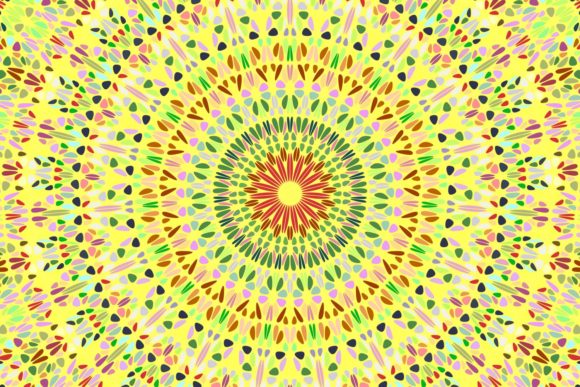
Dynamic Colorful Round Floral Pattern: Elevating Visual Design with Psychedelic Geometry
In the competitive landscape of modern visual communication, capturing attention requires more than just standard imagery; it demands designs that evoke emotion and sustain engagement. The Dynamic Colorful Round Floral Pattern represents a sophisticated intersection of organic aesthetics and mathematical precision. This design style combines the softness of traditional florals with the intensity of geometrical psychedelic circular mosaic patterns, creating a background that is both hypnotic and professionally versatile. For designers, marketers, and content creators, understanding how to leverage this specific vector art form can solve common challenges related to visual fatigue, brand differentiation, and technical scalability.
Understanding the Aesthetic Fusion
The Dynamic Colorful Round Floral Pattern is not merely a repetition of flower shapes. It is a complex arrangement where botanical elements are abstracted into geometric forms, arranged in radial symmetry to create a mandala-like effect. This fusion serves a dual purpose: the floral aspect provides a familiar, welcoming organic connection, while the psychedelic circular mosaic structure introduces a sense of order, rhythm, and infinite depth. Unlike static floral prints, the "dynamic" quality refers to the optical illusion of movement created by high-contrast color gradients and precise angular alignment. This makes the artwork particularly effective for digital mediums where screen luminosity enhances the vibrancy of the vector colors.
Solving Common Design Challenges
Professionals often encounter specific hurdles when sourcing background assets. Identifying these pain points is the first step toward utilizing this resource effectively.
- Resolution Limitations: Raster images often pixelate when scaled for large-format printing or high-DPI displays. Sourcing a design available in JPG 5000x5000 resolution alongside vector EPS and AI files eliminates this barrier entirely.
- Visual Monotony: Solid colors can feel sterile, while photographic backgrounds can distract from foreground text. A hypnotic vector art pattern provides texture and interest without competing with primary content.
- Lack of Customizability: Pre-rendered JPEGs lock you into a specific color palette. Vector formats allow for real-time adjustments to match brand guidelines or seasonal themes.
- Generic Stock Fatigue: Audiences are adept at ignoring cliché imagery. The unique blend of psychedelic geometry and floral motifs offers a fresh alternative to standard corporate or decorative backgrounds.
Practical Applications and Strategic Implementation
The versatility of the Dynamic Colorful Round Floral Pattern extends across multiple disciplines. Success lies in matching the intensity of the pattern to the intended medium and audience response.
Digital Marketing and Web Design
In web environments, this pattern excels as a hero section background or an immersive landing page element. Because the design is radially symmetrical, it naturally draws the eye toward the center. Designers can utilize this focal point to anchor headlines, call-to-action buttons, or product showcases. When using the JPG 5000x5000 version for web, it is crucial to optimize the file size through compression tools to maintain fast load times without sacrificing the crispness of the geometric lines. For responsive design, the vector AI or EPS source allows you to crop or reframe the pattern dynamically for mobile viewports, ensuring the hypnotic effect remains intact on smaller screens.
Print Media and Packaging
For physical products, the high-resolution nature of this asset is paramount. In packaging design, the circular mosaic pattern can suggest premium quality and artisanal care, particularly for cosmetics, wellness products, or specialty foods. The psychedelic coloration works exceptionally well with metallic foils or spot UV varnishes. By isolating specific geometric layers within the AI file, printers can apply special finishes only to the floral segments, creating a tactile contrast against the matte background. The 5000x5000 pixel dimension ensures that even at large print sizes, the edges of the vector-derived shapes remain razor-sharp, avoiding the blur associated with upscaled raster graphics.
Event Branding and Environmental Graphics
Large-scale environmental graphics require assets that do not degrade when stretched across banners, stage backdrops, or exhibition walls. The Dynamic Colorful Round Floral Pattern provides a cohesive visual theme that can unify disparate signage elements. Event planners can use the hypnotic quality of the design to create immersive photo opportunities or wayfinding markers. Because the pattern is abstract, it transcends language barriers and cultural specifics, making it an inclusive choice for international conferences or diverse community events.
Technical Considerations for Optimal Results
To maximize the utility of this resource, users must understand the technical distinctions between the provided file formats. Each format serves a specific stage in the production workflow.
- JPG 5000x5000: Best for immediate use in presentations, mood boards, and web mockups. This format is universally compatible but non-editable. Always check the DPI (dots per inch) before sending to print; 5000 pixels is sufficient for most applications, but verify dimensions relative to your final output size.
- Vector EPS: The industry standard for exchanging vector data between different software platforms. Use this when collaborating with external vendors or printers who may not use Adobe Illustrator. EPS files preserve scalability and color separation data essential for professional printing.
- Vector AI: The native source file for Adobe Illustrator. This is your master copy. Here, you can adjust individual anchor points, modify gradient meshes, recolor specific floral elements, and resize the canvas without any loss of quality. Keep this file archived for future iterations of your project.
Tailoring the Approach for Different User Needs
While the asset is singular, the approach to using the Dynamic Colorful Round Floral Pattern varies significantly based on user expertise and project goals.
For Non-Designers and Small Business Owners: Focus on the JPG 5000x5000 file. Utilize user-friendly platforms like Canva or PowerPoint to overlay white or black semi-transparent shapes behind your text. This ensures readability against the busy psychedelic background. Do not attempt to edit the vector files unless you have training; instead, use the high-res raster version as a reliable, plug-and-play solution.
For Professional Graphic Designers: Treat the AI/EPS files as a foundational kit rather than a finished product. Deconstruct the circular mosaic to create custom borders, icons, or secondary patterns. Experiment with blending modes and opacity masks to integrate the floral hypnotic vector art subtly into existing brand systems. Your goal is adaptation, ensuring the pattern feels bespoke to the client rather than generic.
For Print Specialists: Prioritize color management. Psychedelic designs often utilize RGB gamuts that exceed CMYK print capabilities. Before production, convert the vector files to the appropriate CMYK profile and perform a soft proof to identify out-of-gamut colors. Adjust the saturation of the floral shapes manually to prevent muddy outputs, ensuring the dynamic vibrancy translates accurately from screen to substrate.
Making Informed Creative Decisions
Selecting and implementing a Dynamic Colorful Round Floral Pattern is a strategic decision that balances aesthetic appeal with functional requirements. By recognizing the value of multi-format availability and understanding the psychological impact of radial geometry, creatives can transform a simple background asset into a powerful communication tool. Whether the goal is to enhance digital engagement, elevate packaging prestige, or create immersive environments, the key lies in respecting the technical integrity of the vector art while adapting its hypnotic energy to serve the specific needs of the audience. Ultimately, successful implementation turns a decorative pattern into a functional component of a broader visual strategy, delivering results that are as practical as they are visually stunning.